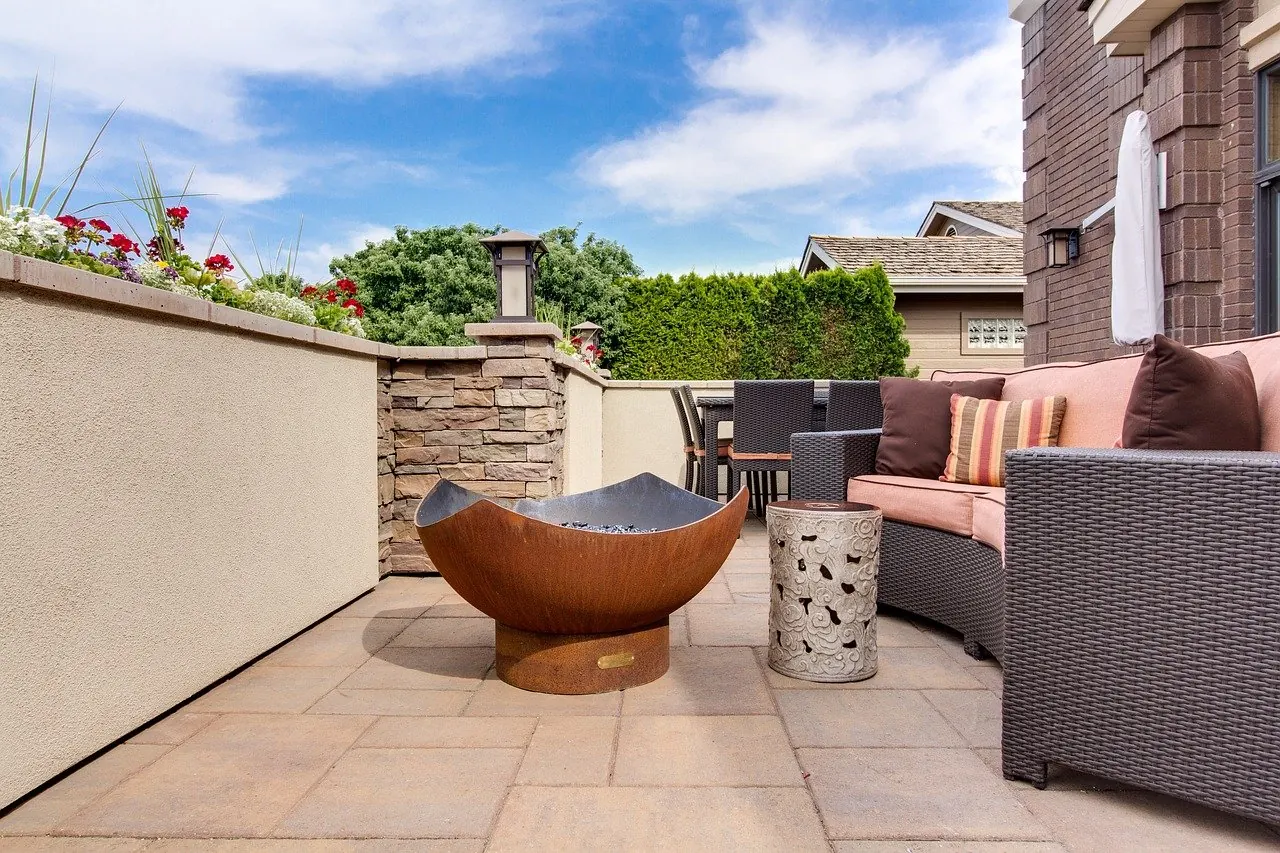
Start with how you will use it
Before we talk patterns or colors, we ask a few plain questions. How many people sit out there on a normal night? Do you cook outside? Where does the sun hit at 6 pm in July? Do the kids need a spot for bikes or a basketball hoop?
Those answers set the size and shape better than any photo. A family that grills twice a week needs room for a grill, a prep table, and a path around them. A couple who mostly sits by a fire wants a cozy circle away from the house. Sketch it out with chalk or a garden hose on the grass before you settle on anything.
- Dining table for six: plan on roughly 12 by 12 feet clear.
- Lounge set with a coffee table: about 10 by 14 feet.
- Grill station with walking room: 6 by 8 feet at minimum.
- Fire pit with chairs around it: a 14 to 16 foot circle.
Extend the builder slab the smart way
Most newer homes here have a small covered slab at the back door. The simplest upgrade is to pour out from it. A straight extension to the full width of the house turns a porch into a real outdoor room.
A step down or a change in finish where the old slab ends can look intentional instead of patched. Some owners keep the covered part plain and put a stamped or exposed aggregate finish on the new section. We dowel the new pour to the old one so they move together on the clay. See our patio cost guide for what an extension runs.
Fire pits and sitting circles
A round pad off the main patio, joined by a short walk or stepping pads, gives you a second spot to sit that feels separate from the house. It also keeps smoke away from the back door and the eaves.
We pour the circle on its own with an isolation joint, so it can move a little without cracking the main slab. If you want a built-in gas fire pit, we run the line or a sleeve under the slab before the pour. A wood-burning bowl just needs a flat, level spot with some clearance from fences and trees. Check your HOA rules on open flames before you commit.
Shade, heat, and the west sun
Many Little Elm back yards face west or have little tree cover, since the neighborhoods are young. A bare slab facing the evening sun can be too hot to use from June to September. Plan shade with the concrete, not after it.
If a pergola or shade sail is in your future, we can pour thickened footings in the slab where the posts go. Light-colored concrete or a light stamp color stays cooler underfoot than charcoal or deep brown. A broom finish in plain gray is a fine choice for a hot, sunny spot.
- Pergola posts: thickened footings poured with the slab.
- Shade sails: separate post footings set outside the slab edge.
- Covered extension: footings sized for the roof load your builder or engineer specifies.
- Cooler surface: light tan, sand, or plain gray finishes.
Outdoor kitchens and built-ins
An outdoor kitchen is heavy. Stone veneer, a countertop, a grill, and a fridge add up fast. We pour that part of the slab thicker with extra steel and pitch it so rain drains away from the cabinets.
Plan the gas, water, and power before we pour. Running conduit and sleeves under the slab costs very little. Cutting a trench through finished concrete later costs a lot and leaves a scar. A low seat wall along one edge of the patio also doubles as extra seating and helps define the space without a fence.
Finishes that hold up here
Here is why we steer people toward certain finishes. Stamped slate and flagstone patterns hide small cracks in their lines and look good next to stone and brick exteriors. Exposed aggregate gives great grip and hides dirt. Broom finish with a smooth border is the low-cost, low-upkeep pick.
Whatever you choose, plan on sealing stamped and colored work every two to three years. Compare the trade-offs in our stamped vs regular concrete guide, then call (469) 430-2766. We will walk the yard with you and sketch a layout on site for free.
Common questions
What patio shape costs the least?
Squares and rectangles. Straight forms go up fast and use less labor than curves. A few gentle curves on one side can soften the look without adding much.
Can a patio and a walkway be poured the same day?
Usually, yes. Pouring a walk to the side gate or a path to a fire pit circle on the same day saves a second truck and a second crew visit.
How close can a fire pit be to my house?
That depends on the type of fire pit, your HOA rules, and Town fire rules. Gas units often have listed clearances from the maker. We will set the pad wherever the rules and the manufacturer say is safe.
Will a bigger patio cause drainage problems?
It can on a flat lot if water has nowhere to go. We pitch the slab away from the house and toward a lower part of the yard, and add a drain when the grade needs it.