Serving Little Elm, Frisco, The Colony, Prosper & the Lewisville Lake area Open 7 days, 7am to 8pm Call (469) 430-2766

Concrete Slabs in Little Elm, TX

Concrete slabs in Little Elm, TX are what most lake households call us about once the garage fills up: a pad beside the house for the boat, a spot for the travel trailer, or a flat floor for a backyard shop or storage shed.

  • Free on-site estimate, itemized in writing
  • Built for Little Elm clay and flat, slow-draining lots
  • Open 7 days, 7am to 8pm

Free Concrete Slabs Estimate

Two quick steps. We call back the same day, usually within the hour.

What are you planning?

Rather talk now? Call (469) 430-2766

Project: Concrete Slabs

No spam, no sharing. Free, written estimate.

Protected by reCAPTCHA. Google Privacy and Terms apply.

Free On-Site EstimatesItemized and in writing
Locally OwnedBased in Little Elm, TX
Built for Texas ClayProper base, rebar, and joints
Residential & CommercialDriveways to parking lots

We grade the site, build up a compacted base, tie the steel, and pour a pad that stays flat under a parked rig for years.

Boat and RV pads for lake households

Lewisville Lake sits a few minutes from almost every street in town, so a lot of our slab work is a side pad for a boat on a trailer, a pontoon, a pair of jet skis, or a camper. Those loads are the tough kind. A trailer tongue and two tires put all the weight on a few small spots, and the rig might not move for an entire winter.

Let's break it down. We pour boat and RV pads at six inches thick with rebar on a grid, not the four inches with wire you find under most builder patios. Plan the size around the real rig plus room to walk around it, hook up, and open a camper's slide-outs. Many HOAs in town have rules on where a boat or RV can sit and whether it must be screened, so read yours before you pick a spot.
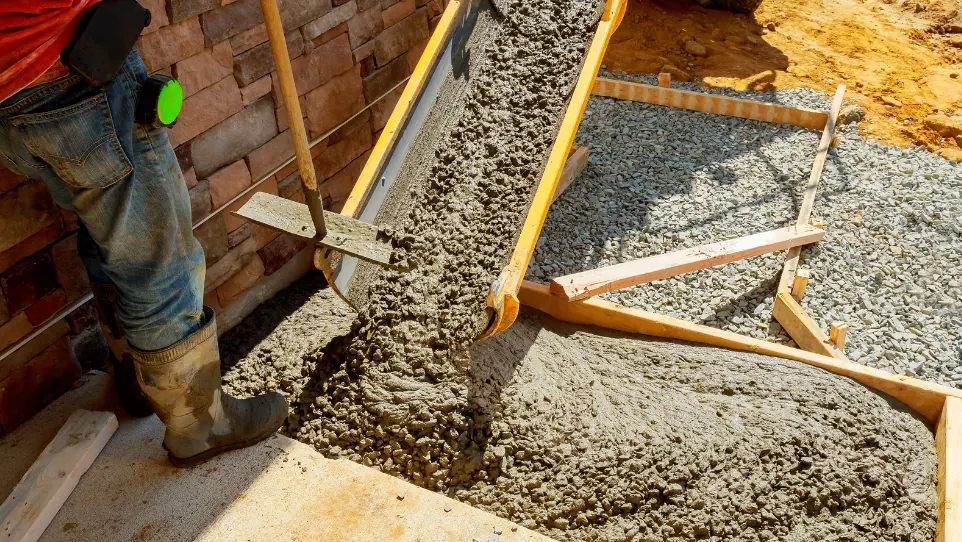
Crew screeding a fresh concrete slab inside wood forms for a boat pad in Little Elm, TX

Shop, shed, and storage building slabs

A steel shop building or a kit shed sits only as square as the pad it bolts to. We set forms to a string line and check grade before the truck arrives so the slab lands flat and true.

Thickness follows the use. A garden shed or a small storage building does fine on four inches with rebar. A shop where you will park a truck, run a lift, or keep a tractor gets a five or six inch slab with deepened edges below the walls. If the building kit calls for anchor bolts in a set pattern, bring us the drawings. We set those bolts in the wet concrete so the frame lines up the day it arrives.

Building a flat pad on wet clay near the lake

Here is why base work matters so much in Little Elm. The ground is Blackland Prairie clay that swells after spring storms and shrinks in a dry August. Lots near the water and in low corners stay damp longer, and some have soft spots that never firm up on their own. Pour on top of that and the slab rides every change in moisture.

So we dig out the soft material, haul in select fill or crushed rock, and compact it in layers. Because most lots here are close to flat, we also build a little fall into the pad so rain runs off instead of sitting under a parked boat. A pad that drains is a pad that stays put.

Planning a pad on a Little Elm lot

Start with access. Most lots here have a side yard between eight and fifteen feet wide, with a fence and a gate at the back. That decides whether a boat can swing in, whether a concrete truck can reach the pour, and whether we need a pump or buggies.

Next, read your HOA rules. Many neighborhoods in Union Park, Spiritas Ranch, and Paloma Creek limit where a boat or RV can park, how long it can stay in view, and what kind of screening is needed. We can pour it behind the fence line or add a screen wall footing in the same visit.

Last, think ahead. If a carport or a lean-to roof might come later, we can set footings or anchor points now while the forms are up. Power conduit for a shop or a light over the boat goes under the slab before the pour, not through it after.
Planning a concrete slabs project? Get a free, itemized estimate from our crew.
Get My Estimate

Our process

How your concrete slabs project goes

  1. 01

    Site visit and written price

    We come out, measure, and check how water moves across your lot. Little Elm yards are mostly flat, so we plan the fall of the slab instead of hoping rain finds its way off. You get a line-by-line price for tear-out, base, steel, and finish.

  2. 02

    Dig out and build the base

    We remove old concrete, cut the soil down to depth, and compact crushed base in layers over the clay. Soft, wet spots near the lake get dug out and replaced, not covered up. Forms go in true to the grade we planned.

  3. 03

    Steel, pour, and finish

    Rebar or mesh goes in on chairs so it sits in the middle of the slab where it does its job. We place the concrete, screed and float it, cut joints at the right spacing, and apply the finish you picked: broom, stamped, exposed aggregate, or smooth.

  4. 04

    Cure, clean up, walk it

    We keep the slab from drying out too fast in the Texas sun, pull the forms, backfill the edges, and haul away the mess. Then we walk the finished work with you and tell you when it can take foot traffic, a car, and a loaded boat trailer.

FAQ

Concrete Slabs questions

What does a boat or RV pad cost in Little Elm?

Plain four-inch broom-finish concrete costs 6 to 10 dollars a square foot installed. Stepping up to a six-inch pad with rebar for a boat or RV adds roughly 1.50 to 3 dollars a square foot. Tearing out old concrete or sod and hauling it off adds 1 to 4 dollars a square foot. Call (469) 430-2766 for a free written estimate.

How big should my boat pad be?

Measure the boat and trailer from tongue to motor, then add about three feet on each side and at the back. That gives room to walk around it, wash it, and back in without dropping a tire off the edge.

Can you tie a new pad into my driveway?

Yes. We dowel steel into the edge of the existing driveway and pour the new pad level with it, with a joint at the seam so each slab can move on its own.

How soon can I park the boat on a new pad?

A light jet ski trailer can roll on after about a week. Leave the heavy camper or the loaded boat off it for roughly four weeks while the concrete gains strength.

Free estimates

Get your free concrete slabs estimate

Call or send a request and we will set up a free on-site visit. You get a written, itemized estimate with no pressure. Open 7 days, 7am to 8pm.

Call Now Free Estimate