A lot of homes in town came with a thin builder-grade slab that is now cracked at the corners or too narrow for a second vehicle. Our crew tears out what failed, fixes the ground under it, and pours a driveway that stays flat and sheds water to the street. Every estimate is free, on site, and itemized in writing.
What we see on Little Elm driveways
Most driveways we look at in Union Park, Paloma Creek, and Spiritas Ranch were poured fast during a building boom. The typical story: four inches of concrete, light wire mesh that ended up on the dirt instead of inside the slab, and joints spaced too far apart. Ten or fifteen years later you get a diagonal crack off the garage corner and a sunken panel near the curb.
Older lots near Main Street have a different problem. Those driveways are often single-car width with a cracked apron where the town sidewalk crosses. Either way, the fix starts below the surface, not with a patch on top.
Boats, trailers, and side pads
Living this close to Lewisville Lake means a lot of households own a boat, a camper, or a utility trailer. A loaded tandem-axle trailer puts far more weight on two small tire patches than a sedan ever will. For that load we pour six inches with rebar on chairs, set at the middle of the slab where it does its job.
Side pads for boat or RV parking are one of our most common Little Elm requests. We check your HOA rules on setbacks and screening first, then pull a Town of Little Elm permit when the work calls for one. The pad gets its own slope so water from the boat cover does not run toward your foundation.
Building drainage into a flat lot
Little Elm is flat. Water does not run off a driveway here unless we build in the fall. We set a steady slope from the garage to the street, and on wide pours we add a slight crown or a valley so rain does not sit in the middle of the slab.
Here is why that matters. Standing water soaks into the Blackland clay along the edges, the clay swells, and the slab edge lifts. Then a dry August shrinks it back and the edge drops. A driveway that drains well keeps the soil under it closer to the same moisture all year, and that is what keeps the concrete in one piece.
Finish choices for the approach
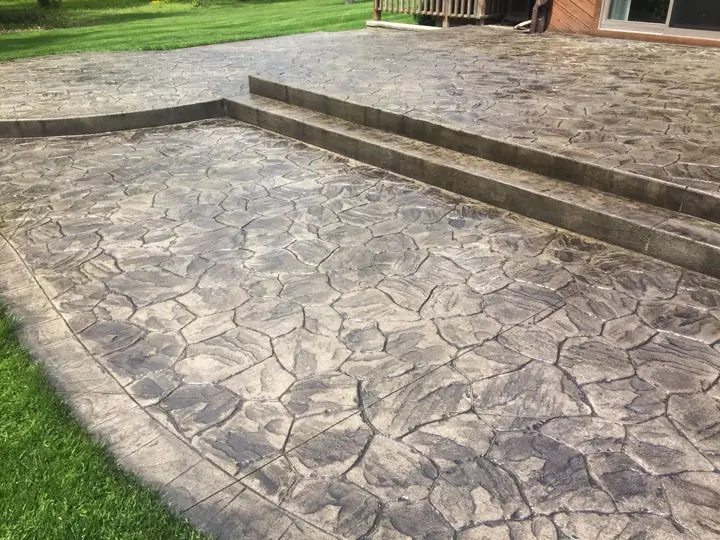
Broom texture is our default for driveways because tires and shoes grip it in the rain and it hides tire marks. If you want the front of the house to stand out, a stamped or exposed aggregate border along the edges costs far less than doing the whole slab that way.
We also talk about sealing. A clear sealer on a new driveway helps it shrug off oil drips, fertilizer stains, and the red clay that washes off the yard after a storm. Most owners reseal every few years, and it takes an afternoon.
Boats, a third car, and the HOA: Little Elm driveway asks
Half the driveway calls we get in Little Elm start with the lake. Somebody bought a bass boat or a pontoon, and the trailer tongue now hangs over the sidewalk or sits on the grass where the tires leave ruts. We fix that with a side pad poured 6 inches thick over rebar, sized to the trailer plus room to walk around it. That extra thickness runs roughly $1.50 to $3 per sq ft over a standard 4 inch pour.
The other common ask is widening for a third car. Most builder driveways in Union Park, Spiritas Ranch, and Paloma Creek are two cars wide and stop at the garage edge. We saw-cut a clean line, dowel the new section into the old slab so the two move together, and match the broom texture as close as fresh concrete allows. Many HOAs here want a site sketch before any widening, so we draw one up with your estimate and you can submit it to the board.
Then there is the apron, the strip between your driveway and the street. It takes the heaviest loads and sits right where the gutter water runs, so it cracks first. When we replace one, we cut back to sound concrete, set the grade so runoff stays in the gutter, and pour it thick enough for a loaded truck and trailer swinging in from the street.